

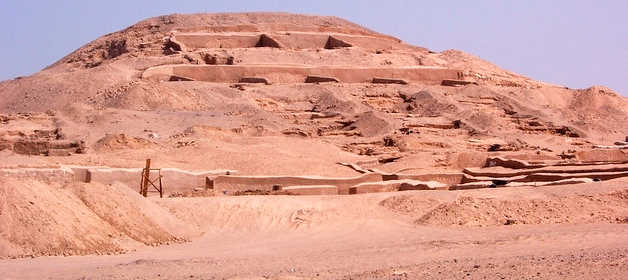
Cahuachi is one of the largest and most important archaeological complexes on Peru’s southern coast. It is located in the Nazca River Valley, approximately 28 kilometers (17 miles) from the city of Nazca, in the Ica region. The settlement covers nearly 24 km² (9.3 mi²) and consists of truncated pyramids, platforms, plazas, enclosures, and massive walls built primarily with adobe.
Cahuachi was one of the main ceremonial centers of the Nazca culture, where communities from different valleys gathered to participate in rituals, present offerings, and perform burials. Its architecture and the archaeological materials recovered indicate that ceremonies, pilgrimages, burials, and activities related to social and religious organization took place here. Archaeologists have also identified evidence of limited residential occupation in certain sectors, meaning that it was not a completely uninhabited site, although it was not a densely populated city in the conventional sense.
The origins of Cahuachi date back to approximately 200 BC. Its greatest period of development occurred during the Early Nazca period, between about 50 BC and AD 450. During these centuries, ceremonial buildings were expanded, and natural hills were transformed through the construction of fills, terraces, adobe platforms, and retaining walls.
Cahuachi served as a gathering place for communities from different valleys along Peru’s southern coast. At various times of the year, people from nearby valleys traveled to Cahuachi to take part in ceremonies and leave offerings. Archaeological excavations have uncovered polychrome ceramics, textiles, musical instruments, food remains, funerary remains, and other ritual objects.
Many of these ceremonies were likely related to water, agricultural fertility, crop production, and the forces of nature. These themes were fundamental for populations living in a desert region that depended on seasonal rivers and irrigation systems. Representations associated with the earth, water, agriculture, and supernatural beings appear throughout Nazca architecture, pottery, and textiles.
By the fourth century and the beginning of the fifth century AD, several ceremonial buildings ceased to be used in the same way. Some spaces were intentionally sealed or covered, and the site's ceremonial importance gradually declined. Nevertheless, certain areas continued to be used later, especially for burials and other ritual activities.
The name Cahuachi is commonly translated as “the place where the seers live.” However, the exact origin of the name has not been conclusively established. Therefore, this interpretation should be presented as a widely accepted explanation rather than a definitively proven etymology, since historical and linguistic sources do not fully explain its origin or formation.
The archaeological complex is located on the left bank of the Nazca River, in the district and province of Nazca, within Peru’s Ica region. It lies in a desert landscape near the San José and Atarco plains, where several Nazca geoglyphs are also found. The site stands at an elevation of approximately 360 to 380 meters (1,181–1,247 ft) above sea level, according to published measurements.
Cahuachi is located within the same cultural landscape as the Nazca Lines. Although they are different archaeological sites, both contribute to understanding the religious and territorial importance of this region during the Nazca period. Archaeological research has proposed ceremonial and territorial connections between them, although this subject continues to be studied.
The archaeological complex of Cahuachi is located approximately 28 kilometers (17 miles) from the city of Nazca. The trip takes between 30 and 40 minutes by road, depending on the type of vehicle and road conditions.
On your own
You can hire a taxi or private transportation from Nazca. Most of the route follows an unpaved road, so it is advisable to use a vehicle suitable for this type of terrain.
With a guided tour
Many travel agencies in Nazca offer tours to Cahuachi, usually combined with visits to the Nazca Lines viewpoints, Chauchilla Cemetery, or local museums. These tours generally include transportation and a professional guide.
The Great Pyramid is the largest structure at Cahuachi and one of the most important constructions of the Nazca culture. It rises approximately 20 meters (66 feet) above the surrounding terrain and was built with adobe bricks and compacted earth.
Archaeologists believe this structure served ceremonial and administrative functions. Excavations have uncovered offerings, pottery, textiles, and evidence of ritual activities.
The Great Temple consists of a series of platforms, plazas, and ceremonial spaces connected by ramps and passageways. It is considered one of the main ritual sectors of the archaeological complex.
Several ceremonial objects and offerings have been discovered here, reinforcing the idea that this was an important place for public religious ceremonies.
This structure is characterized by its stepped platforms, which provided access to higher ceremonial areas. Its architectural design reflects the planning and engineering skills of the Nazca culture.
Researchers believe that rituals and gatherings of pilgrims may have taken place on these elevated platforms.
The Orange Pyramid owes its name to the characteristic color of the adobe used in its construction. It is one of the best-known buildings within the complex and forms part of the ceremonial core of Cahuachi.
Although only part of the original structure remains visible today, archaeological studies indicate that it played an important role in the site's ritual activities.
Throughout the archaeological complex, visitors can observe large open plazas, ceremonial platforms, walls, ramps, passageways, and adobe buildings distributed across the desert landscape.
These structures demonstrate the scale of Cahuachi and its importance as one of the largest ceremonial centers built by the Nazca culture.
According to tourism information published by Peru’s Ministry of Foreign Trade and Tourism, admission has been free, and visiting hours have been from 7:00 a.m. to 5:00 p.m. It is recommended to confirm this information before traveling, as it may change.
Because archaeological work, conservation activities, or road conditions may temporarily affect access, it is advisable to confirm the current schedule and visiting conditions with the Tourist Information Office or the Provincial Municipality of Nazca before your visit.
There is no mandatory official visit duration. Exploring the area open to visitors usually takes approximately one to one and a half hours. Including round-trip transportation from Nazca, it is advisable to set aside between two and a half and three and a half hours.
The excursion may take longer when it includes La Estaquería, artisan workshops, the Antonini Archaeological Museum, or other attractions in the Nazca Valley.
The best option is to visit Cahuachi in the morning, when the heat is more manageable. If you prefer to go in the afternoon, make sure to arrive with enough time before closing.
It is recommended to bring water, sunscreen, a hat or cap, sunglasses, lightweight clothing, closed-toe shoes, and a windbreaker. It is also useful to carry cash for transportation or local services.
Visitors should walk only along authorized trails and within permitted areas. Climbing on walls, removing pottery fragments, entering closed areas, or touching restored structures is not allowed.
Although Cahuachi can be visited independently, hiring a local guide will help you identify the main buildings, understand their ceremonial functions, and make better use of your visit.

How long does the visit take?
Exploring the area open to visitors may take between one and one and a half hours. Including transportation from Nazca, it is advisable to set aside half a day or at least approximately three hours.
Can Cahuachi be visited without a guide?
The official information does not state that a guide is mandatory. However, visiting Cahuachi with a local guide or a trusted travel agency is recommended, especially if you want to learn more about the site and arrange transportation along the unpaved road.
How far is Cahuachi from Nazca?
Cahuachi is located approximately 27 to 28 kilometers (17 miles) from the city of Nazca. The road journey usually takes between 35 and 45 minutes each way.
Is Cahuachi part of the Nazca Lines?
Cahuachi and the geoglyphs belong to the same broader cultural landscape of the Río Grande de Nazca Basin, and chronological and ceremonial connections exist between them. However, they are different archaeological sites and should not be presented as a single monument.
Was Cahuachi an inhabited city?
Its main function was ceremonial and religious. There is evidence of domestic activities and of people living in certain sectors, but it does not appear to have had a large and permanent urban population comparable to that of a major ancient city.
Why is Cahuachi important?
Cahuachi is important because it preserves adobe pyramids, ceremonial plazas, burials, and offerings that help explain how Nazca society lived and practiced its rituals. Its buildings, textiles, pottery, burials, and offerings are among the main sources used to study the cultural development of Peru’s ancient southern coast.

Happy passengers