

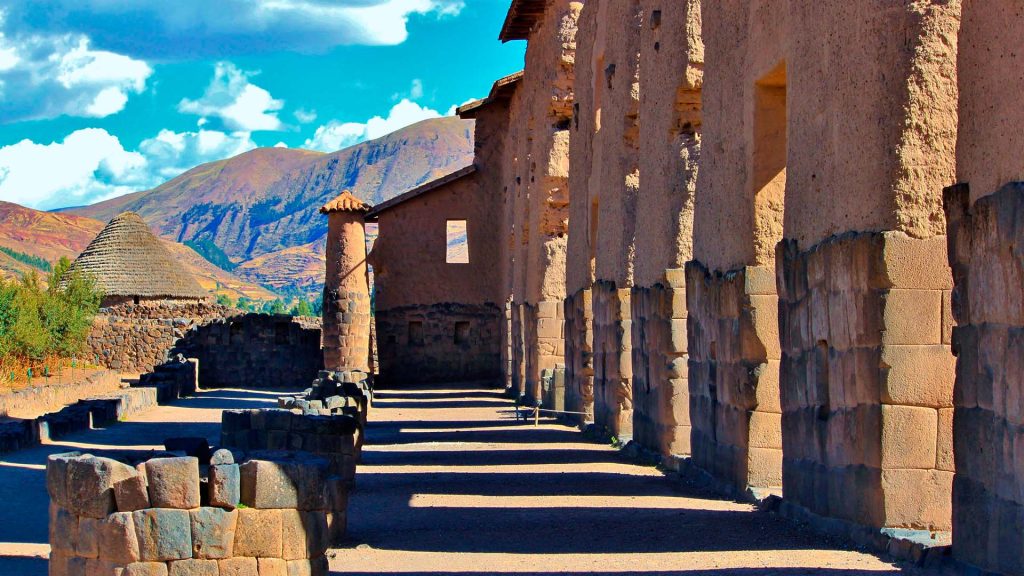
The Raqchi Archaeological Park is one of the most important Inca complexes in the South Valley of Cusco. It is best known for the Temple of Wiracocha, a monumental construction dedicated to one of the most important deities of the Andean world.
During your visit, you can explore ancient Inca enclosures, qolqas or circular storehouses, ceremonial fountains, stone and adobe walls, ancient paths, and spaces that show the religious, administrative, and economic importance this place had during the Inca period.
In addition to its archaeological value, Raqchi maintains a strong connection with the living culture of the area. The local community preserves traditions, artisan activities, festivities, and typical gastronomy that enrich the traveler's experience.
Table of Contents
Raqchi is an Inca archaeological complex located in the district of San Pedro, province of Canchis, in the Cusco region. It was an important ceremonial, administrative, and possibly territorial control center along the route to Collasuyo, one of the four great regions of the Tahuantinsuyo.
The site stands out for the presence of the Temple of Wiracocha, a large construction that combines stone foundations with adobe walls. Unlike other Inca temples, this building had an unusual monumental structure, with a high central wall and side columns that may have supported a large roof.
Raqchi was not only a religious space. Its group of storehouses, enclosures, fountains, and paths shows that it also fulfilled administrative, logistical, and food storage functions.
The history of Raqchi is related to the Inca expansion toward the southern Andes. Its strategic location, near the Vilcanota River and the ancient road to the high plateau, made it possible to control routes, resources, and areas of exchange between Cusco, Canchis, Puno, and other regions.
According to the tradition recorded by some chroniclers, the place was associated with the Inca Wiracocha and was later expanded or modified during the governments of other Incas, such as Pachacútec and Túpac Yupanqui. However, these attributions should be understood as historical references and not as a completely fixed archaeological chronology.
The Temple of Wiracocha was the main building of the complex. Its architecture shows a combination of stone and adobe, materials used in a planned way to raise a structure of great dimensions. It is believed that this temple was dedicated to Wiracocha, considered a creator deity within the Andean worldview.
In addition to the temple, the archaeological park includes numerous storehouses or qolqas, rectangular enclosures, water fountains, paths, and remains of a large wall. These elements indicate that Raqchi was a highly important center within Inca organization.
Raqchi is located in the district of San Pedro, province of Canchis, Cusco region. It lies southeast of the city of Cusco, on the route that connects Cusco with Puno.
The distance from the city of Cusco is approximately 110 to 119 kilometers, depending on the departure point and the route taken. The road trip usually takes between 2 and a half and 3 hours.
The complex is located at an approximate altitude of 3,450 meters above sea level, in a temperate-cold area surrounded by mountains, agricultural fields, and landscapes typical of the Vilcanota Valley.
To get to Raqchi from the city of Cusco, you must take the road heading south, passing through towns such as Oropesa, Andahuaylillas, Urcos, Quiquijana, and Combapata until you reach the district of San Pedro.
There are three main ways to get there:
By organized tour: This is the most comfortable option for travelers who want to visit Raqchi together with other attractions in the South Valley or along the Cusco - Puno Route of the Sun.
By private transportation: This allows greater flexibility to make stops at other nearby places, such as Andahuaylillas, Tipon, or the Huacarpay Lagoon.
By public transportation: You can take a bus or shared van heading toward Sicuani or Puno and get off near the entrance to Raqchi. However, this option requires more planning and checking return schedules in advance.
Raqchi is one of the most important stops on the Route of the Sun, a tourist route that connects the city of Cusco with Puno. This route usually includes attractions such as the church of Andahuaylillas, known as the Sistine Chapel of America; the Raqchi archaeological complex; the La Raya pass; and the Pucará lithic museum.
Thanks to its location, Raqchi helps visitors better understand the historical connection between Cusco and the high plateau. It was part of an important axis of communication, exchange, and territorial control during the Inca period.
For those traveling from Cusco to Puno, visiting Raqchi is an excellent opportunity to discover an archaeological site that is different from the more traditional sites in the city of Cusco.
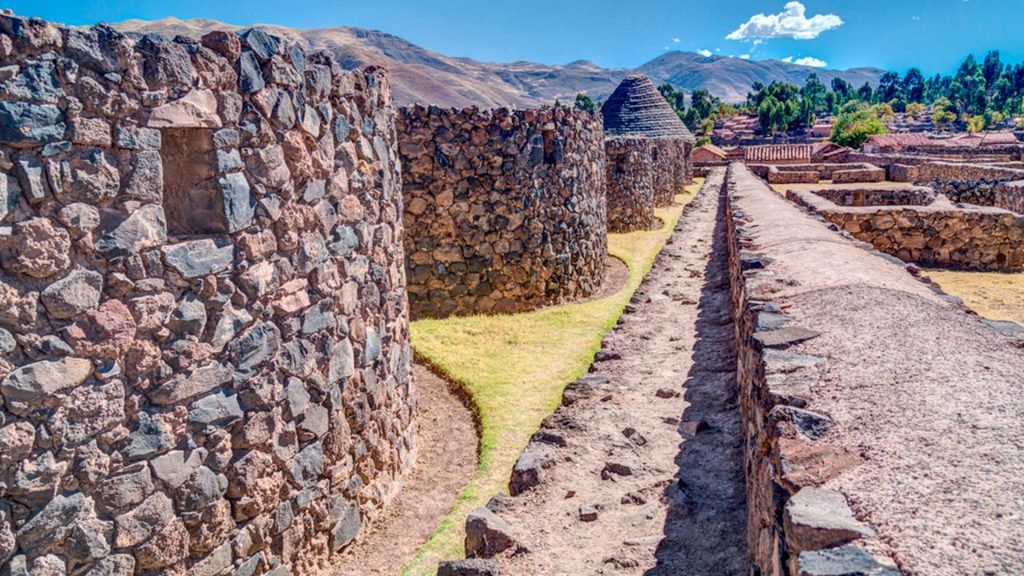
The Temple of Wiracocha is the most representative construction in Raqchi. It is a monumental building raised on a stone foundation with adobe walls. Its large central wall is one of the most striking elements of the complex and allows visitors to imagine the magnitude the temple had during the Inca period.
This space may have been dedicated to Wiracocha, one of the most important deities of the Andes. Due to its size, design, and location, it is considered to have had a highly relevant ceremonial function.
The temple stands out because it has an architectural style different from that of other Inca sites. Its dimensions, the layout of its walls, and the possible existence of a large roof make it one of the most unique works of ancient Peru.
Near the temple, there are several rectangular enclosures that may have served administrative, ceremonial, or residential functions. These spaces show the planning of the complex and the internal organization of the site.
Some of these enclosures may have been related to authorities, priests, temple attendants, or people in charge of managing products and activities within Raqchi.
The qolqas of Raqchi are circular storehouses built to store agricultural products such as corn, potatoes, quinoa, and other foods. These structures are located in a sector near the enclosures and show the logistical importance of the complex.
Raqchi has more than 150 storehouses, which shows that it was not only a ceremonial center but also a key space for the administration and preservation of food. These products may have supplied travelers, authorities, workers, and populations connected to the Inca road.
Another attraction in Raqchi is its water fountains. These structures reflect the hydraulic knowledge of the Incas and the symbolic importance of water within Andean culture.
The best-known fountain is traditionally called the Inca Bath. It is built with carved stone and preserves a design that shows the precision with which the Incas channeled water.
In addition to their practical function, these fountains may have had a ceremonial use, since water was considered a sacred element associated with fertility, purification, and life.
The Raqchi complex preserves remains of a large wall that delimited part of the site. This structure may have served functions related to protection, access control, or ceremonial delimitation.
The presence of this wall reinforces the idea that Raqchi was a place of great importance within Inca organization, not only because of its temple but also because of its territorial planning.
Raqchi is also known for its folk festival, a cultural celebration that brings together music, traditional dances, typical clothing, and local gastronomy. This event usually takes place in June and is a good opportunity to discover the living culture of the province of Canchis.
During the festival, different groups present dances and artistic expressions from the region. If you want to visit Raqchi during this date, it is advisable to confirm the exact day of the celebration in advance, as it may vary depending on local organization.
A visit to Raqchi can also be complemented by the area's traditional gastronomy. The most representative dishes include baked guinea pig, quinoa soup, olluco with meat, dishes made with native potatoes, corn, and other Andean products.
Local cuisine has a strong connection with the region's ingredients. Many dishes are prepared with products grown in nearby communities, allowing visitors to enjoy a more authentic experience.

Visiting hours may vary depending on the site's administration, the season, or local regulations. On many tourist routes, the visit takes place in the morning or around midday, especially within the Cusco - Puno Route of the Sun.
Before traveling, it is recommended to confirm the updated schedule with a local agency, the site administration, or the tour operator in charge of the route.
Entrance to Raqchi is usually paid at the archaeological site itself. The price may vary for national visitors, foreign visitors, students, or residents.
Some tourist references mention an approximate fee of 15 soles, but it is advisable to verify the current price before the visit, as rates may change.
The weather in Raqchi is temperate-cold. During the day it may feel pleasant under the sun, but because of the altitude and wind, the temperature can drop quickly.
The dry season, from May to October, is usually the most recommended time to visit the complex, as there is less rain and better conditions for walking and taking photographs.
The rainy season, from November to April, also allows visits to Raqchi, although it is important to bring a waterproof poncho, shoes with good grip, and protection for electronic equipment.
The best time to visit Raqchi is during the dry season, especially between May and October. During these months, the sky is usually clearer, the paths are in better condition, and the landscape offers good visibility.
If you visit during the rainy season, it is best to plan your visit in the morning, when the weather is usually more stable.
To visit Raqchi, it is recommended to bring comfortable shoes, sunscreen, a cap or hat, water, a light jacket, an identity document, cash, and a camera or phone with enough battery.
During the rainy season, it is important to bring a waterproof poncho or water-resistant jacket. It is also recommended to avoid carrying heavy objects, as the tour is done on foot through open areas.
Set aside at least 45 minutes to 1 hour to explore the main sectors of the complex. If you want to visit the site more calmly, take photographs, and learn about the local community, you may want to consider spending more time.
Respect the marked areas, avoid climbing on the walls, do not remove stones or fragments from the site, and follow the instructions of the staff in charge. Raqchi is a protected archaeological heritage site, and its conservation also depends on visitors' behavior.
To better understand the history of the site, it is recommended to take the visit with a specialized guide. Many structures may seem simple at first glance, but with a proper explanation, it is easier to understand their religious, administrative, and symbolic function.
How long does it take to get to Raqchi from Cusco?
The trip from Cusco to Raqchi usually takes between 2 and a half and 3 hours by road, depending on traffic, the type of transportation, and the stops made along the route.
What can you see in Raqchi?
In Raqchi, you can visit the Temple of Wiracocha, the qolqas or circular storehouses, Inca enclosures, ceremonial fountains, remains of walls, ancient paths, and spaces related to the living culture of the local community.
Who was Wiracocha?
Wiracocha was one of the most important deities of the Andean world. He is considered a creator deity, associated with the origin of the world, order, and life.
Is Raqchi part of the Route of the Sun?
Yes. Raqchi is one of the most important stops on the Cusco - Puno Route of the Sun, together with other attractions such as Andahuaylillas, La Raya, and Pucará.
What is the best time to visit Raqchi?
The best time to visit Raqchi is between May and October, during the dry season. During these months, there is less rain and better conditions for exploring the site.
Can Raqchi be visited without a guide?
Yes, Raqchi can be visited without a guide. However, to better understand the importance of the Temple of Wiracocha, the qolqas, the fountains, and the function of the complex, it is recommended to take the visit with a specialized guide.
How much does the entrance to Raqchi cost?
The entrance fee may vary. Some tourist references mention an approximate fee of 15 soles, but it is recommended to confirm the updated price before the visit.
What typical dishes can you try in Raqchi?
In Raqchi and its surroundings, you can try traditional dishes such as baked guinea pig, quinoa soup, olluco with meat, dishes made with native potatoes, corn, and other Andean products.

Happy passengers